Residential Lighting: Applications and Limits of No-Main-Light Design
We break down the ceiling-height demands of no-main-light lighting design and common colour-temperature myths, and why owners should not chase the trend blindly.
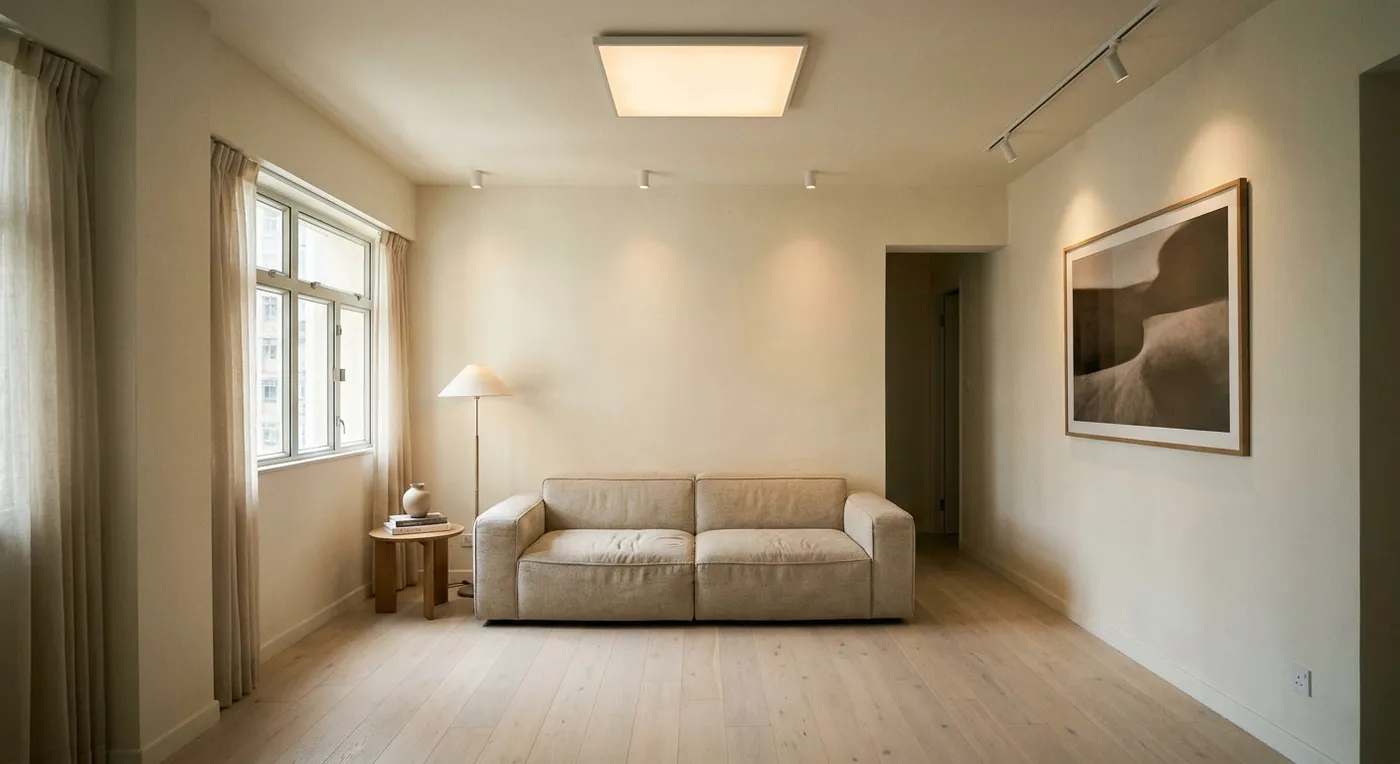
In recent years, interior design has seen a wave of “no main light” lighting schemes, and plenty of owners walk in saying “I want a flat ceiling throughout, with spotlights everywhere.” As a designer, I will not say this approach is categorically wrong, but I have personally seen far too many cases where owners regret it once the renovation is done: either the lighting is not bright enough, or the space starts to feel oppressive. Today, we examine a few of the most common lighting design myths.
Myth 1: Does a No-Main-Light Design Automatically Look Premium?
The appeal of a no-main-light design is even lighting, and not having to think about pendant light styles. But here is the objective fact first: a no-main-light design demands a lot from your ceiling height. A standard Hong Kong flat has roughly 8 feet of ceiling height; add a flat false ceiling on top (which usually drops the ceiling by 4 to 6 inches), and your actual usable height comes down to around 7.5 feet. Walk into a room like that and it feels stifling, especially in front of the TV in the living room, where staring at a low ceiling for long stretches can genuinely feel psychologically uncomfortable. On top of that, spotlights positioned too close to a wall throw uneven pools of light across it, which actually draws more attention to any imperfections in the wall surface.
If your home is already in a new development with 9 feet of ceiling height or more, then a no-main-light design is entirely workable. Otherwise, consider a slim flush-mount ceiling light as your main fixture instead, supplemented with spotlights or LED strips to build atmosphere.
Myth 2: Is Brighter Always Better for T5 Cove Lighting?
Many tradespeople habitually run T5 fluorescent tubes inside a cove ceiling, and owners, chasing “bright and lively,” specifically ask for an extra-high colour temperature (6500K). But this is another trap: overly bright indirect lighting actually flattens a space, stripping it of depth. Light from a cove ceiling bounces upward and is already softened by the time it reflects back down, but if the colour temperature is too high, it turns a cold blue, closer to a hospital than a home. I would recommend a warm white in the 3000K to 3500K range, with brightness pitched just enough to serve as ambient light. Task lighting (reading lamps, bedside lights) should be handled separately with its own fixtures.
A Few Objective Lighting Tips
There is no absolute right or wrong in lighting design: what matters most is weighing it against your own layout and lifestyle. The above is simply my own experience. If you are planning the lighting layout for a new home renovation, please contact our team to discuss your design needs. Electrical work should be carried out by a registered electrical worker.
Discuss your space
Share your floor plan or photographs for a considered assessment of design possibilities, practical constraints and budget.