Light Luxury Interiors: Design Quality and Budget Allocation
We debunk three 'light luxury' renovation myths in Hong Kong (real marble, excess gold, and over-decorated surfaces) and suggest cheaper alternatives.
“Light luxury” style has become very popular in Hong Kong home design lately: it can feel like a space is not stylish enough unless it has marble and brass somewhere in it. But there is a big misconception at the heart of this trend: the assumption that piling on expensive materials automatically equals luxury. As a designer who works constantly between site and materials, I have seen many cases where money was spent and the result still came out looking inconsistent. Setting the “dream home” platitudes aside, this piece takes an objective look at the three most common misconceptions, so you can avoid spending on things you do not actually need.
Misconception One: Does Light Luxury Mean Covering Everything in Real Marble?
The moment homeowners hear “light luxury,” many of them say, “I want Italian Calacatta marble.” But the reality is: a full slab of marble shipped to Hong Kong, once you factor in installation, polishing and crystallisation, can be very costly, and since most Hong Kong flats have small usable footprints, a TV feature wall is more likely to need visible seams, making the result look fragmented rather than seamless. More importantly, marble’s natural porosity stains easily, particularly on a kitchen backsplash or near a window, and years later you may end up with yellowing or water marks that are hard to remedy.
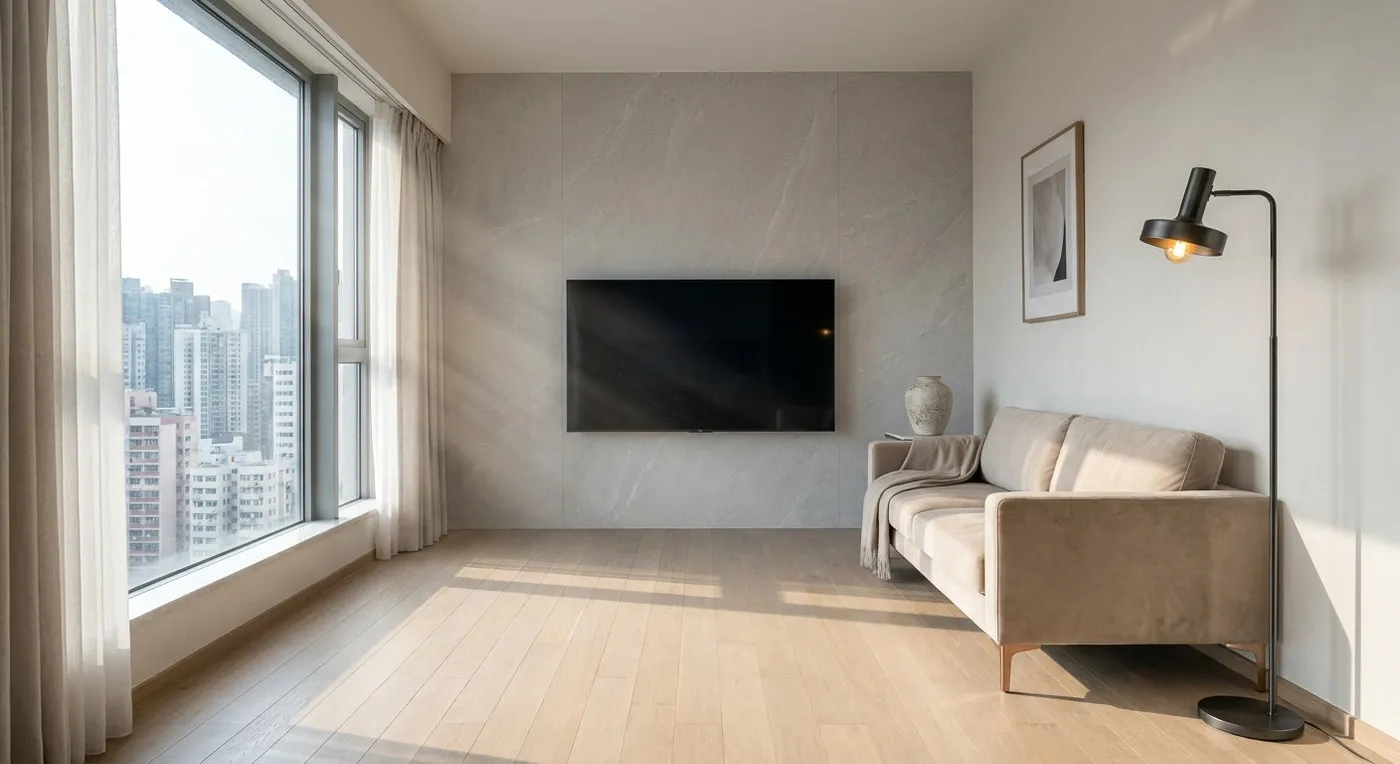
Rather than insisting on real stone, we would recommend sintered stone or marble-effect porcelain tile for large surfaces. These materials are harder, have very low water absorption, and need no waxing: the pattern is high-resolution printed and convincing to the eye, and the price is generally lower than real stone. The one thing to watch is that sintered stone panels are brittle at the edges, so installers need to cut them carefully to avoid chipping.
Misconception Two: Does More Gold Mean More Luxury? It Often Reads as Cheap
Another classic misstep: gold stainless-steel trim everywhere, gold light fixtures, gold door frames. The result is a unit that ends up looking like an old-school members’ club dripping in gilt. The essence of light luxury is “light” and “refined,” not “flashy.” A more suitable approach is to keep metal accents to roughly 10-15% of the total surface area, concentrated on details: a lamp base, a cabinet handle, or a slim skirting line.
As for colour, we would recommend matte brushed rose gold or gunmetal, and avoid glossy gold. Glossy metal reflects light aggressively, which easily reads as cheap, and fingerprints show up immediately, so it needs frequent cleaning.
Misconception Three: Does Light Luxury Have to Fill Every Surface? Restraint Is What Reads as High-End
Many homeowners see a light-luxury unit in a magazine (decorative moulding on every cabinet door, wall, and ceiling) and assume that filling every surface is what constitutes good design. In reality, those magazine shoots rely heavily on styling: soft furnishings, flowers, and rugs create the sense of layering. The truth is, you are not going to put fresh flowers on the coffee table every day, or swap out dried arrangements weekly. Once that styling is stripped away, a space built on decorative excess starts to feel overwrought and cramped.
The most successful light-luxury projects we have seen are, in fact, the ones that know how to leave things be. For example: a light base colour throughout (a pale grey or off-white), a single textured feature wall behind the TV, and everything else kept simple with plain plaster and paint. Furniture with clean lines, metal legs, or velvet upholstery is enough to set the mood on its own. Whatever you save can go toward a better sofa or a handmade silk rug: practical, and durable.
Conclusion: Judge by Actual Conditions
Light luxury needs careful handling, because the margin is narrow: overdo it and it turns gaudy, underdo it and it just reads as ordinary modern. As consultants, we will not ask you to follow our advice to the letter, because every unit differs in light, proportion and use. What matters most is knowing how much “luxury” and how much “light” you actually want. If you have questions about material trade-offs or budget allocation, please contact our team: we will give you candid advice grounded in the actual conditions of your home.
Discuss your space
Share your floor plan or photographs for a considered assessment of design possibilities, practical constraints and budget.