Brutalism in Hong Kong Homes: Concrete, Steel and Scale
How careful use of concrete, stainless steel, and warm lighting can translate Brutalism into a workable design language within Hong Kong's 8-foot ceilings and humid climate.
We recently came across an art collector’s apartment in Milan: Brutalism paired with a sunken conversation pit, the whole space quiet yet full of tension. But bring that back to Hong Kong, where your flat has an 8-foot ceiling, 300 square feet of usable space, humidity, and plaster that cracks easily. How do you actually borrow from that? This is not about replicating a four-storey Milanese mansion. It is about starting from a philosophy of materials: how to use an honest, what-you-see-is-what-you-get visual language to build a home with real character, even within a low ceiling.
Before You Try Brutalism, Face Three Realities
The core of Brutalism is materials that tell the truth: exposed concrete, stainless steel, raw, unfinished formwork marks. But in Hong Kong’s residential environment, these materials come with real physical limitations. I often remind clients: do not sacrifice comfort for the sake of style. What matters is choosing the right kind of raw.
Creating Rich Texture from Limited Materials
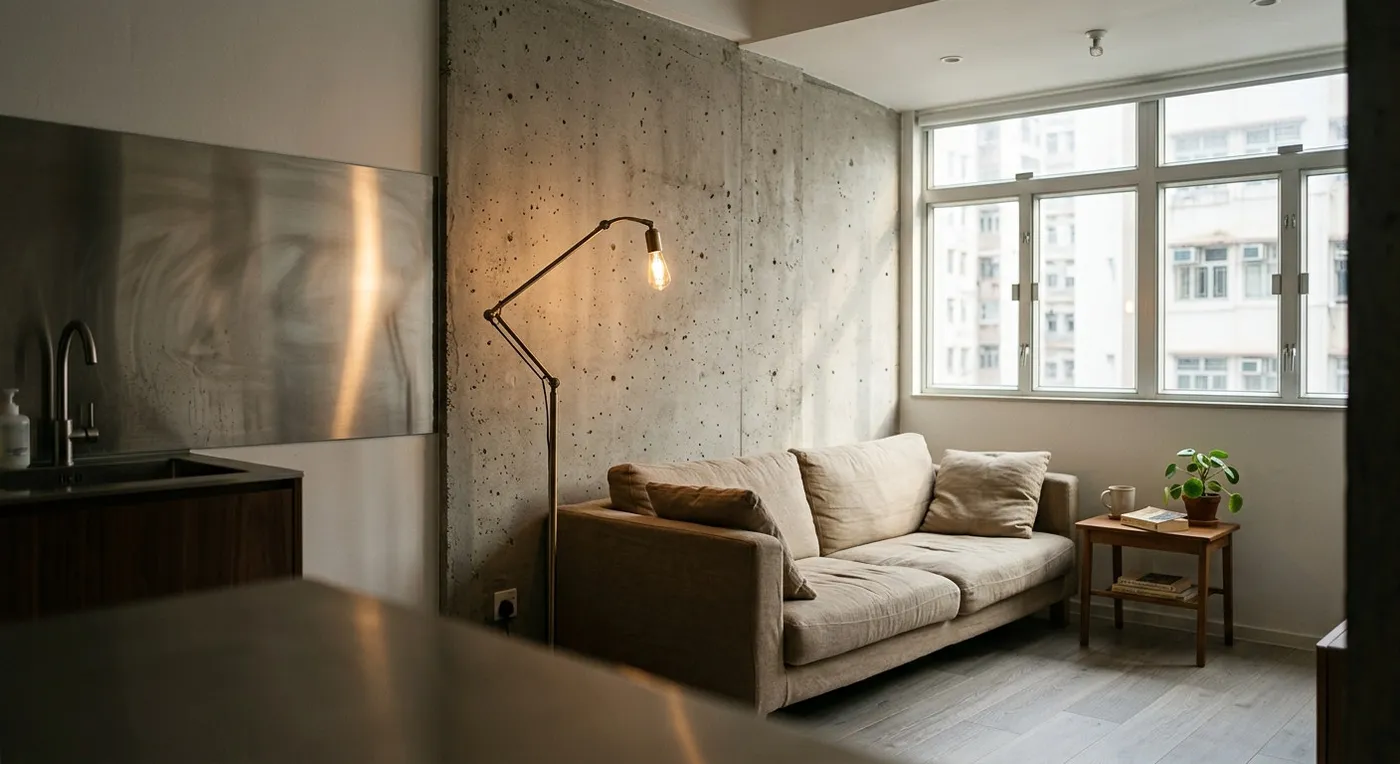
CLAY once tried this for a client in Mid-Levels: the whole flat used only three main materials, namely exposed concrete (confined to one section, given structural limits), a stainless steel stove splashback, and pale grey oak flooring. The approach kept the concrete to the low TV wall, using vertical metal lines to draw the eye upward; the stainless steel was limited to the area behind the stove, so it did not chill the whole flat. The client’s verdict: “The whole place feels raw, but still warm.” The key is balance: using raw materials as accents, not blanketing the whole home in them.
If you want to try this look yourself, keep a few principles in mind: first, as a rough guide, keep metal and concrete together to about 30% of the space or less; second, use warm lighting (2700K) to counter the cold feel; third, bring in soft furnishings like a linen sofa or wool rug to create tactile contrast.
From Milan to Hong Kong: Translating a Design Philosophy Locally
That Milan apartment is a work of art, but a Hong Kong home is a vessel for daily life. There is no need to deliberately expose rebar. Instead, you can bring in a sense of rawness through detail: board-formed concrete texture on a single feature wall, or hand-applied plaster left with an uneven finish. Brutalism is not really a style: it is an attitude, accepting imperfection, respecting what a material actually is. It can be applied in Hong Kong, but it needs to be adjusted to the conditions of the space.
If you are facing a similar design question, please contact our team to discuss your project.
Discuss your space
Share your floor plan or photographs for a considered assessment of design possibilities, practical constraints and budget.