Faye Toogood’s Organic Furniture: Proportion and Texture at Home
Faye Toogood's organic furniture raises real questions of scale, material breathability and craftsmanship for small Hong Kong flats.
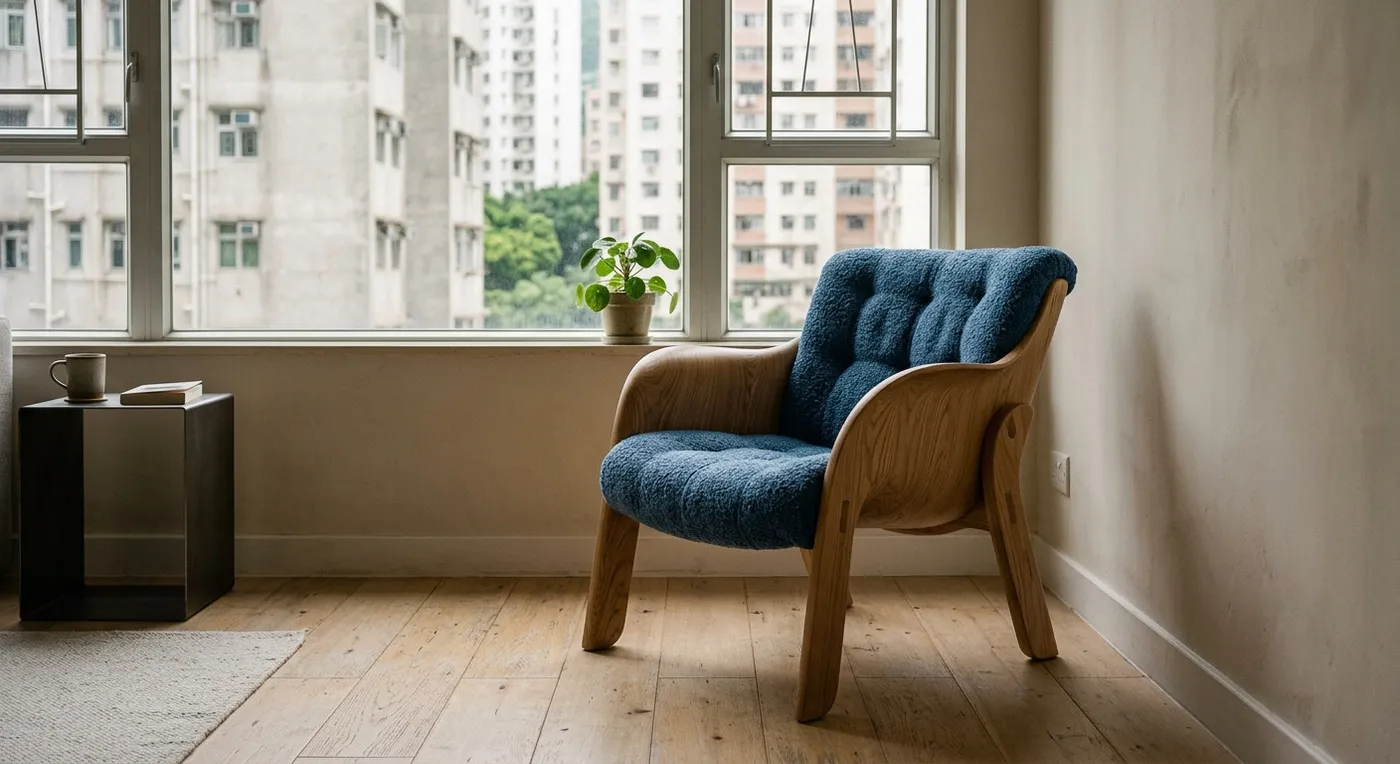
British designer Faye Toogood’s latest furniture collection, “Bone, Roll, Slump,” takes its inspiration from unearthed fossils and bones found in mud, wrapping soft wool upholstery around curved oak frames so each piece reads almost like a sculpture. But plenty of Hong Kong homeowners see furniture like this and immediately wonder: can a flat this small actually accommodate something with this much visual “weight”? In this piece, CLAY Interior looks at the real pros and cons of organic-form furniture through the lens of material and spatial psychology, so you do not get swept away purely by how good it looks.
Organic Form: Soft Sculpture Within a Space
The Bone chair’s back and seat have no straight edges at all. It is more like a stone smoothed round by running water. In a space with Hong Kong’s standard 8-foot ceiling, curved furniture like this actually offers a real advantage: it softens the visual pressure of sharp corners. Furniture built on straight lines can feel rigid and hard-edged, whereas organic curves let the eye flow naturally, which makes a space feel more generous by comparison. One thing to watch, though: curved furniture usually takes up more floor area than you would expect. The Bone armchair has a depth of roughly 75cm, so in a 300-square-foot open-plan flat you will need to measure carefully before committing.
Tactile Materials: The Reality of Wool, Coconut Husk and Latex
Toogood builds each piece from layered materials (wool, coconut husk and latex), finished with a white or blue bouclé fabric cover. That combination needs some care in Hong Kong’s humidity: coconut husk and latex are breathable, but they are also prone to mould, especially if the piece sits against a wall or in a poorly ventilated corner. A workaround is to swap in synthetic fibres for some of the natural fill, or to dehumidify the room regularly. Bouclé, meanwhile, feels pleasant to the touch but is harder to clean, and Hong Kong’s dust levels do not help, so it is best to choose a darker colourway or a removable, washable cover.
Craft Meets Technology: The Precision of 5-Axis CNC, With a Handmade Touch
The Roll collection’s bedside table is shaped using 5-axis CNC machining and then hand-finished. That hybrid approach is worth paying attention to: high-precision machining helps ensure structural stability, while the handwork gives each piece its own distinctive texture. Not every local Hong Kong woodworking shop has equipment at that scale, but if you are commissioning custom furniture, you can ask the manufacturer for proof of 5-axis machining capability to make sure the curved surfaces come out smooth.
Toogood’s designs are, at their core, a careful experiment in material and form, but bringing that into a Hong Kong interior means considering the practical side too. If you are facing a similar design question, please contact our team to discuss your requirements.
Discuss your space
Share your floor plan or photographs for a considered assessment of design possibilities, practical constraints and budget.