Indoor Pool Materials: Comparing Stainless Steel and Tile
New York's floating pool and its stainless-steel liner frame this look at moisture resistance, structural load, and upkeep for stainless steel versus tile in Hong Kong pools.
We recently saw news that +Pool, the floating pool project on New York’s East River, is nearing completion. What caught our attention was not whether it floats: it is how the project uses a stainless-steel liner and a chlorine-free filtration system to solve the problem of permanent submersion. That thinking has real relevance for residential indoor pools, spas, and even oversized bathtubs in Hong Kong. Whenever you are planning to bring a water feature into a home, material choice is always the first thing that can trip you up.
The Material Myth: Stainless Steel or Tile, Which Suits Hong Kong Better?
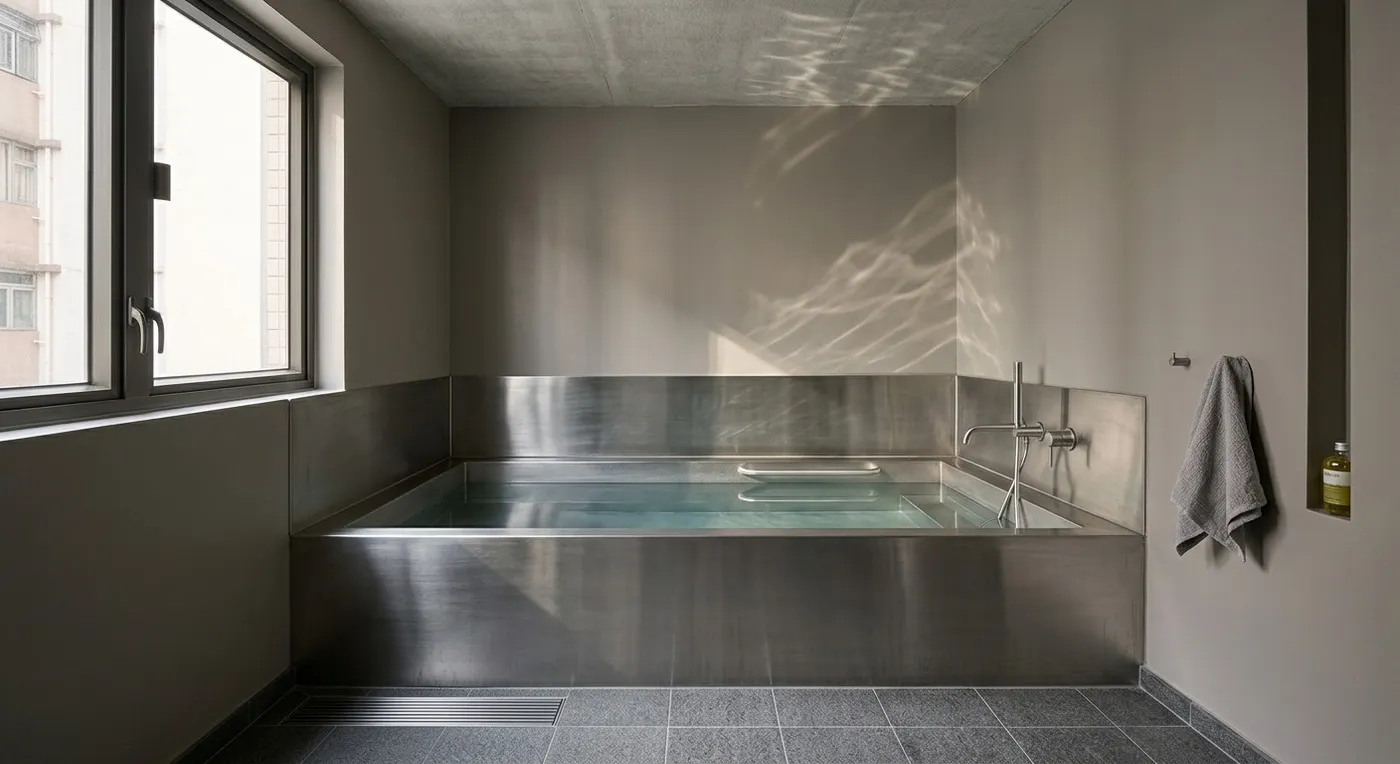
Many clients assume tile is simply the more attractive choice for an indoor pool, without accounting for mould in Hong Kong’s humid environment or how waterproofing membranes age over time. Stainless steel (particularly 316L marine-grade) actually performs more consistently on waterproofing, bacterial resistance, and maintenance, and because it has no grout lines, there is far less surface for dirt to collect in.
One thing many designers overlook is structural load: an indoor pool needs the floor slab reinforced. You cannot just lay waterproofing over the existing structure and call it done. Work involving floor-slab reinforcement and pool installation should be assessed by a qualified professional, such as a registered structural engineer, and approved by the Buildings Department where required. Hong Kong flats typically have a low standard ceiling height of 2.4 metres, so installing a spa pool can eat up a large share of that height, and you need to reserve space in advance for lighting and dehumidification.
To be fair, it is not that stainless steel is always better and tile is always worse. If your budget is tight and you just want a small foot-soak pool, tile with regular re-waterproofing will hold up fine for a few years. But if you are planning for the long term and do not want to be tearing everything out and redoing it two years from now, stainless steel paired with chlorine-free filtration is the more reliable choice.
As for style, most Hong Kong homes lean towards modern minimalism, and stainless steel’s mirror-like finish actually pairs well with grey tones and timber. It does not read as cold as you might expect. Tile, on the other hand, gives you room to play with vintage geometric patterns. Each has its place.
If you are facing a similar design dilemma, our team can help assess your options. We will give you an honest read on what actually works for your situation.
Discuss your space
Share your floor plan or photographs for a considered assessment of design possibilities, practical constraints and budget.