Bamboo and Furniture in Acoustic Design: Structure and Sound
Drawing on an IKEA Hackers DIY speaker built from a bamboo panel, how material density and room acoustics play out in small Hong Kong flats.
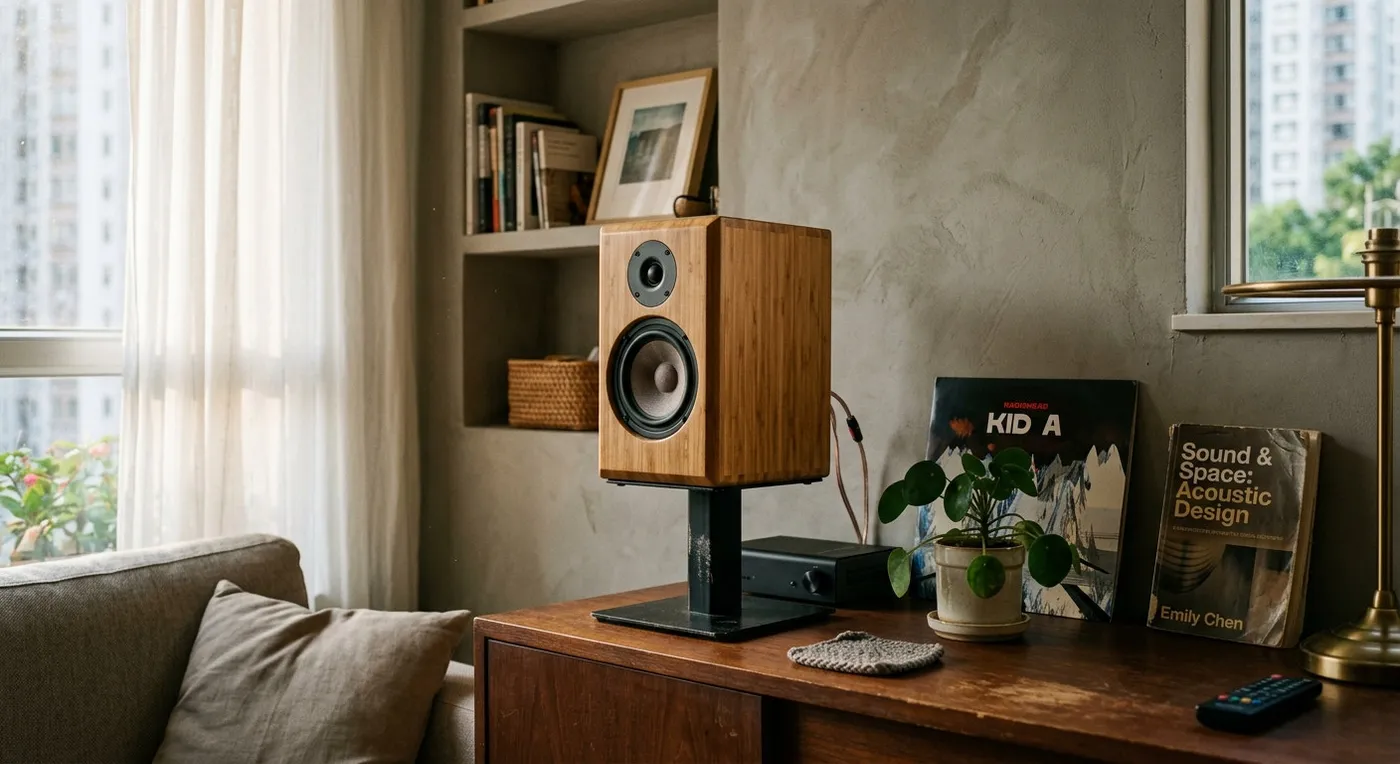
Plenty of people assume good sound has to come from expensive equipment, but the reality is that the room itself is the biggest variable of all. We recently came across a project shared on IKEA Hackers: audio enthusiast David Kan built a pair of DIY speakers from three IKEA Vivalla brackets and a thin bamboo panel, claiming they rival dedicated speaker cabinets. His idea was to treat the speaker enclosure like a piano soundboard, rather than something meant purely to seal off sound. It is a concept that ties directly into interior design: a material’s density, shape, and how it is mounted all directly affect how sound spreads and gets absorbed in a space.
Bamboo as a speaker enclosure: faithful reproduction, or acoustic risk?
David used a thin bamboo panel because it is rigid enough yet light, letting it vibrate along with the driver and effectively “sing,” similar to the principle behind a piano’s resonance chamber. But that approach is not free of trade-offs: a thin panel is prone to coloration, where certain frequencies get amplified or suppressed. Hong Kong flats tend to be especially small, which makes speaker placement highly sensitive, and a traditional thick MDF cabinet is actually easier to control in that context. We often advise clients to understand, before chasing good sound, whether their listening environment leans absorptive or reflective. As an acoustic material, bamboo’s upsides are that it is eco-friendly, has attractive grain, and diffuses mid-to-high frequencies naturally; its downside is that low frequencies tend to spread poorly, and in a small room that can leave the bass sounding muddy.
From IKEA Hackers to local spaces: three takeaways
David’s experiment is a useful prompt: rather than chasing a perfectly sealed enclosure, it is worth letting the room and its furniture participate in the sound. Using an IKEA Kallax shelf to store records, or lining a wall with cork panelling, can function as acoustic treatment in its own right. But keep in mind that a material’s thickness, porosity, and how it is mounted all affect the outcome.
This kind of design is bold, but physically sound. It just will not suit every Hong Kong “nest.” If you love jazz, vocals, or classical chamber music, this “thin-panel enclosure” approach can sound genuinely captivating; but if you mostly listen to electronic music or watch films with heavy bass, a traditional sealed cabinet is probably the safer bet. Before choosing materials or speaker placement, it is worth understanding your own listening habits and your room’s real constraints first. That is the most rational design mindset.
If you are facing a similar design question, please contact our team to discuss your requirements.
Discuss your space
Share your floor plan or photographs for a considered assessment of design possibilities, practical constraints and budget.