Rammed Earth and Blackened Timber in Humid Environments
Drawing on RIBA's 2026 UK Building of the Year shortlist, this piece unpacks the real limitations of rammed earth and blackened wood in Hong Kong's humid climate.
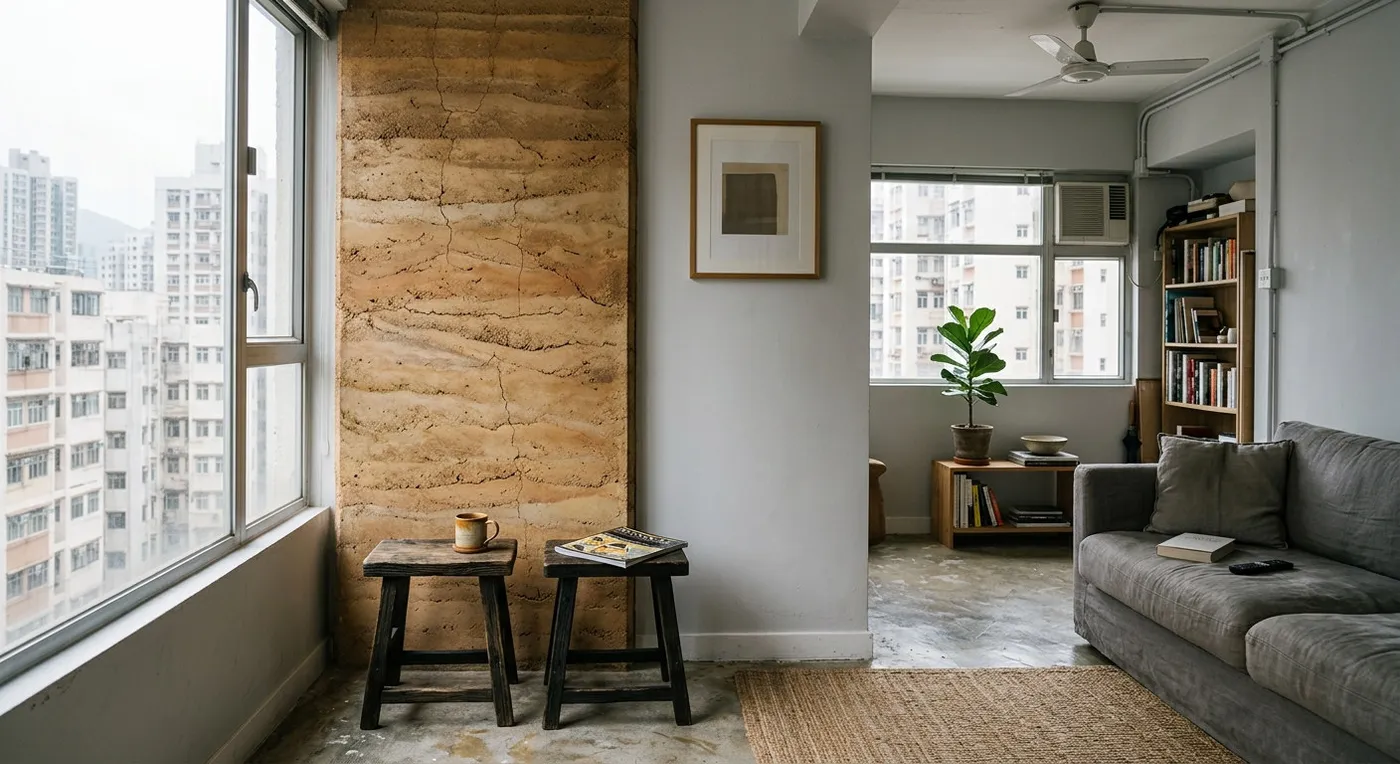
This week RIBA announced its 2026 UK Building of the Year shortlist, and two projects stood out: Tuckey Design Studio’s rammed-earth house, and a Scottish Highlands farmhouse extension clad in blackened larch. Plenty of Hong Kong homeowners see that raw, natural texture and immediately wonder if they can bring it home. But as designers who have worked hands-on across Hong Kong Island, Kowloon and the New Territories, we have to pour a little cold water on the idea: natural materials often look stunning in photos but perform poorly inside a Hong Kong interior.
Rammed Earth: Full of Character, But Humidity Is the Real Enemy
Rammed-earth walls are formed from compacted soil, sand and small stones. They have high thermal mass, which delays heat transfer in summer and, in theory, suits an Asian climate. But Hong Kong’s relative humidity sits above 80% for much of the year, and rammed earth is a porous material that absorbs moisture readily. Once a wall takes on water, without the right damp-proofing and surface treatment it will quickly start to mould, flake, and even lose structural strength. With Hong Kong’s standard 8-foot residential ceiling, a rammed-earth wall’s sheer thickness eats into an already tight footprint, and construction is slow, expensive, and hard to maintain. If you are set on the look, the safest approach is to limit it to a dry zone, such as a section of the entrance foyer, with a waterproof layer at the base and a breathable lime-plaster finish on top. Even then, the result will inevitably fall short of the images you have seen from overseas. A new wall adds loading, so it should be assessed by a qualified professional, with Buildings Department approval obtained where required.
Blackened Wood: Stylish, But Not Every Timber Will Do
Blackened larch is created by treating the timber surface with a vinegar-and-iron solution, which reacts with the wood’s tannins to darken it naturally, with no chemical stain needed, and is said to offer some decay resistance. But this technique is designed for well-ventilated outdoor settings. Bring it indoors as flooring or wall cladding in a Hong Kong flat, where air-con and heating cycle back and forth, and the timber will expand and contract more than usual, making it prone to warping. The blackened surface also remains porous, so sweat, oil and pet saliva soak straight in, making it far harder to keep clean. A common misconception is that any wood can be “blackened” simply by darkening it. In fact, many species simply do not have enough tannin content to react properly. You need European larch or American black walnut to get the effect at all, and the cost can be markedly higher than engineered hardwood flooring.
Three Common Mistakes to Avoid
If you are weighing a similar design dilemma, please contact our team to discuss your requirements. We can give you an objective read on the physical constraints of your specific space, without pushing any particular material.
Discuss your space
Share your floor plan or photographs for a considered assessment of design possibilities, practical constraints and budget.